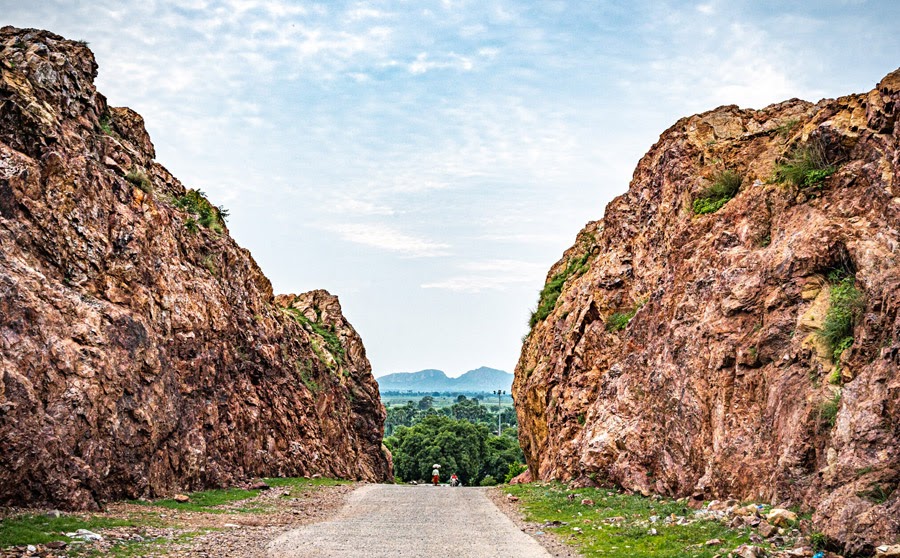
In the village of Gehlaur, in Bihar, India, a wall of rock stood between the people and everything they needed. The mountain ridge forced villagers to walk some 70 kilometers around it to reach the nearest town — its market, its doctors, its hospital. For the poor laborers of Gehlaur, that distance was simply a fact of life. Until, one day, it became a tragedy.
The day that broke his heart
Dashrath Manjhi was a poor laborer who worked in the fields beyond the mountain. Each day, his wife, Falguni Devi, would cross the rocky ridge carrying his lunch and water. One day in 1959, she slipped on the treacherous path and was badly injured. With no road, there was no quick way to reach a doctor; the nearest hospital lay on the far side of that enormous detour around the mountain. Falguni Devi died before help could reach her.
Manjhi was devastated — and then, he was determined. If the mountain had taken his wife, then the mountain would have to move. He made a vow: he would carve a road through the ridge himself, so that no one in his village would ever again die waiting for help that was so close, yet so impossibly far.
Twenty-two years of hammer blows
In 1960, Manjhi sold his goats to buy a hammer and a chisel, and climbed up to the ridge. Then he started chipping. Villagers laughed at him. They called him a madman, a fool possessed. He worked in the fields to feed his family, and in every spare hour — in scorching heat and in rain — he climbed back to his mountain and struck the stone.
People called him mad. He answered them one hammer blow at a time — for twenty-two years.
Day after day, year after year, the notch in the mountain grew. Slowly, the laughter faded. Some villagers began bringing him food. Others started to believe. And in 1982 — twenty-two years after he had begun — Dashrath Manjhi walked through the mountain.
The road love built
The path he carved is roughly 110 meters long and up to 9 meters wide, cut as much as 7.5 meters deep into solid rock. What it did for Gehlaur is hard to overstate: the journey to the nearest town and hospital, once a punishing trek of dozens of kilometers around the ridge, shrank to a fraction of what it had been. Children could reach school. The sick could reach doctors. A village that had been cut off from the world was connected to it — by one man's grief, and one man's refusal to let that grief be the end of the story.
India came to know him as the "Mountain Man." The government of Bihar honored him, and after his death in 2007, the road he carved was officially named the Dashrath Manjhi Path. He never became rich, and he never asked to be. He had only wanted one thing: that what happened to Falguni would never happen to anyone else.
Mountains, it turns out, are no match for love with a hammer. All it takes is twenty-two years — and a heart that will not quit.